
Digital-First or Left Behind: Call to Action on the UK Construction Products Reform
Digital-First or Left Behind: Call to Action on the UK Construction Products Reform
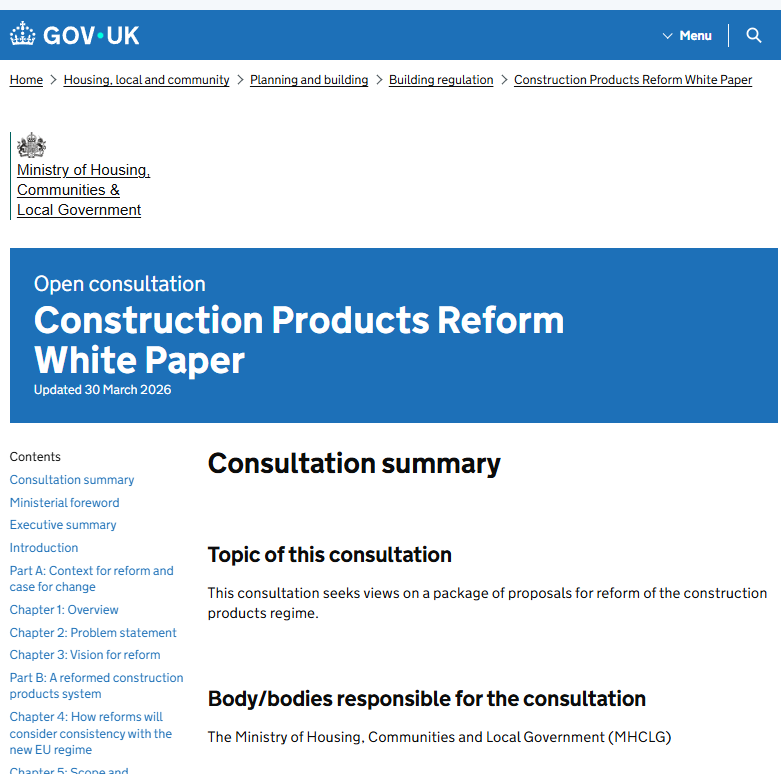
The UK Government is planning to transform UK construction products compliance, by putting safety, accountability, and transparency first. To this end the Construction Products Reform White Paper, published in March 2026 by the Ministry of Housing, Communities and Local Government, represents the most ambitious overhaul of UK construction product regulation since the Grenfell tragedy.
As a digital service provider specialising in Digital Product Passports and Digital Building Logbooks, Eco Wise welcomes the ambition of these reforms — but our response to the current consultation raises a clear warning: without placing digital infrastructure at the heart of reform, and without aligning closely with the EU's rapidly evolving construction product regulatory framework, the UK risks creating a system that is both harder to enforce and more burdensome for industry.
We propose three key principles that are needed to make the reforms work:
- Digital infrastructure must come first - the White Paper's "digital first" language is undefined and sequencing the digital disclosure and digital traceability system to later legislative sessions is a strategic error. Without creating standardised digital disclosure from the outset on construction products performance, safety and environmental impacts, and making full use of digital automation, the amount of work required for both producers and enforcers is insurmountable.
- Clearer guidance on which standards apply - the reforms necessitate a government portal to help producers navigate which standards apply to their products, given the wide variety and nature of both products and applicable standards. Producers need clarity on what rules they need to adhere to.
- EU alignment is existential - the reforms do not recognise major existing and proposed compliance changes in the EU market for construction products. Manufacturers selling in the UK and EU will face two very different regimes in terms of product safety, performance and environmental disclosures by 2029 based on the current proposal. Significant increasing costs due to the need to comply with two different disclosure systems and significant differences in what needs to be disclosed.
Clearer guidance Is urgently needed
We highlighted a persistent problem that construction producers consult Eco Wise for: manufacturers frequently struggle to navigate which rules and standards apply to their products. The boundary for construction products between harmonised products, non-harmonised products with a European Technical Assessment, and products that fall outside both categories is not intuitive — and the consequences of getting it wrong can be severe. Manufacturers without proper compliance guidance can end up with incomplete compliance information, apply safety testing twice (once for the EU, once for the UK) whilst this could have been avoided.
Our recommendation is straightforward: guidance must be specific, practical, and ideally delivered through for industry through a government-run online portal. A producer should be able to input information about their product and receive tailored, reliable guidance on which standards apply — including when the General Safety Requirement is triggered. This is not a luxury; it is a prerequisite for effective compliance.
Accountability without digital infrastructure is hollow
The biggest challenge concerns creating a digital system of accountability and digital enforcement. The White Paper references a "digital first" approach to market surveillance (paragraph 7.5.24) but leaves this entirely undefined. There are no concrete digital disclosure requirements for manufacturers or economic operators placing products on the UK market — no registration system, no automated conformity checks, no structured data trail.
This stands in sharp contrast to what is already underway in the EU. The European Sustainability and Products Regulation (ESPR) and the EU Construction Products Regulation (CPR) 2024 are establishing a mandatory Digital Product Passport (DPP) registry. The registry will include a basic DPP conformity verification check at the point of product registration. And only one this check is passed will a passport certificate for the product be issued. The proof that the product can be placed on the EU market. The conformity verification check can be extended to automatically evaluate that product safety disclosure information is in place in the DPP, and available for market surveillance and enforcement.
Our advice to the UK government is unambiguous: the digital product disclosure system and traceability system must come first, not last. Sequencing this reform into a later legislative session — as the current plan implies — is a critical mistake. Digital data disclosure is the cornerstone of safety, accountability, and effective enforcement. It needs primary legislation and it needs to be prioritised. The UK risks significantly lagging behind on data automation in the construction sector with a significant productivity gap to the EU as a result.
Alignment With the EU Is Not Optional
The Construction products White Paper Reform does not recognise the significant changes underway in the EU market. UK manufacturers exporting to the EU will, under the current proposed UK approach, need to maintain two entirely separate compliance routes: one for UK sales, one for EU sales. This is not hypothetical divergence — it is a near-term operational burden for some of the most important product categories in the construction sector. The first of construction product families affected — cement, reinforced steel, windows and doors, thermal insulation — will face these requirements around 2029.
Selling construction products into the EU will over time require Digital product Passports, a Digital Declaration of Performance & Conformity, and a mandatory LCA for environmental performance linked to EN 15804+A2. UK sales will require none of these elements, and maintain EN 15804+A2 LCAs and EPDs as voluntary. The only similarity is the proposed General Product Safety regulation for construction products, which matches with the recently introduced EU General Product Safety Regulation.
The EU Product Act (expected September 2026) will go even further and propose a full overhaul of EU market surveillance and the New Legislative Framework (NLF) defining how products are placed on the EU market and the main responsibilities of each party in the process. The NLF also covers construction products (as well as 85% of products sold on the EU market). The approach in the legislative discussions includes linking of the DPP registry to market surveillance digital tools, easier direct digital access to compliance documentation, and routes for automated conformity checks. The EU product act will include a horizontal DPP requirement for 85% of products sold on the EU market over time by 2035. Discussions initiated by the legislator in consultations even include a possible abolishment of the CE mark and replacing it with Digital Product Passport compliance data management and digital conformity verification.
Eco Wise to this end urges the UK Government to evaluate the impact on divergence of the UK with the EU for exporters, and the impact on the overall UK economy. The main path forward is to ensure alignment awith the EU Construction Products Regulation 2024 and the upcoming EU Product Act.

.svg)
.svg)
The UK Government is planning to transform UK construction products compliance, by putting safety, accountability, and transparency first. To this end the Construction Products Reform White Paper, published in March 2026 by the Ministry of Housing, Communities and Local Government, represents the most ambitious overhaul of UK construction product regulation since the Grenfell tragedy.
As a digital service provider specialising in Digital Product Passports and Digital Building Logbooks, Eco Wise welcomes the ambition of these reforms — but our response to the current consultation raises a clear warning: without placing digital infrastructure at the heart of reform, and without aligning closely with the EU's rapidly evolving construction product regulatory framework, the UK risks creating a system that is both harder to enforce and more burdensome for industry.
We propose three key principles that are needed to make the reforms work:
- Digital infrastructure must come first - the White Paper's "digital first" language is undefined and sequencing the digital disclosure and digital traceability system to later legislative sessions is a strategic error. Without creating standardised digital disclosure from the outset on construction products performance, safety and environmental impacts, and making full use of digital automation, the amount of work required for both producers and enforcers is insurmountable.
- Clearer guidance on which standards apply - the reforms necessitate a government portal to help producers navigate which standards apply to their products, given the wide variety and nature of both products and applicable standards. Producers need clarity on what rules they need to adhere to.
- EU alignment is existential - the reforms do not recognise major existing and proposed compliance changes in the EU market for construction products. Manufacturers selling in the UK and EU will face two very different regimes in terms of product safety, performance and environmental disclosures by 2029 based on the current proposal. Significant increasing costs due to the need to comply with two different disclosure systems and significant differences in what needs to be disclosed.
Clearer guidance Is urgently needed
We highlighted a persistent problem that construction producers consult Eco Wise for: manufacturers frequently struggle to navigate which rules and standards apply to their products. The boundary for construction products between harmonised products, non-harmonised products with a European Technical Assessment, and products that fall outside both categories is not intuitive — and the consequences of getting it wrong can be severe. Manufacturers without proper compliance guidance can end up with incomplete compliance information, apply safety testing twice (once for the EU, once for the UK) whilst this could have been avoided.
Our recommendation is straightforward: guidance must be specific, practical, and ideally delivered through for industry through a government-run online portal. A producer should be able to input information about their product and receive tailored, reliable guidance on which standards apply — including when the General Safety Requirement is triggered. This is not a luxury; it is a prerequisite for effective compliance.
Accountability without digital infrastructure is hollow
The biggest challenge concerns creating a digital system of accountability and digital enforcement. The White Paper references a "digital first" approach to market surveillance (paragraph 7.5.24) but leaves this entirely undefined. There are no concrete digital disclosure requirements for manufacturers or economic operators placing products on the UK market — no registration system, no automated conformity checks, no structured data trail.
This stands in sharp contrast to what is already underway in the EU. The European Sustainability and Products Regulation (ESPR) and the EU Construction Products Regulation (CPR) 2024 are establishing a mandatory Digital Product Passport (DPP) registry. The registry will include a basic DPP conformity verification check at the point of product registration. And only one this check is passed will a passport certificate for the product be issued. The proof that the product can be placed on the EU market. The conformity verification check can be extended to automatically evaluate that product safety disclosure information is in place in the DPP, and available for market surveillance and enforcement.
Our advice to the UK government is unambiguous: the digital product disclosure system and traceability system must come first, not last. Sequencing this reform into a later legislative session — as the current plan implies — is a critical mistake. Digital data disclosure is the cornerstone of safety, accountability, and effective enforcement. It needs primary legislation and it needs to be prioritised. The UK risks significantly lagging behind on data automation in the construction sector with a significant productivity gap to the EU as a result.
Alignment With the EU Is Not Optional
The Construction products White Paper Reform does not recognise the significant changes underway in the EU market. UK manufacturers exporting to the EU will, under the current proposed UK approach, need to maintain two entirely separate compliance routes: one for UK sales, one for EU sales. This is not hypothetical divergence — it is a near-term operational burden for some of the most important product categories in the construction sector. The first of construction product families affected — cement, reinforced steel, windows and doors, thermal insulation — will face these requirements around 2029.
Selling construction products into the EU will over time require Digital product Passports, a Digital Declaration of Performance & Conformity, and a mandatory LCA for environmental performance linked to EN 15804+A2. UK sales will require none of these elements, and maintain EN 15804+A2 LCAs and EPDs as voluntary. The only similarity is the proposed General Product Safety regulation for construction products, which matches with the recently introduced EU General Product Safety Regulation.
The EU Product Act (expected September 2026) will go even further and propose a full overhaul of EU market surveillance and the New Legislative Framework (NLF) defining how products are placed on the EU market and the main responsibilities of each party in the process. The NLF also covers construction products (as well as 85% of products sold on the EU market). The approach in the legislative discussions includes linking of the DPP registry to market surveillance digital tools, easier direct digital access to compliance documentation, and routes for automated conformity checks. The EU product act will include a horizontal DPP requirement for 85% of products sold on the EU market over time by 2035. Discussions initiated by the legislator in consultations even include a possible abolishment of the CE mark and replacing it with Digital Product Passport compliance data management and digital conformity verification.
Eco Wise to this end urges the UK Government to evaluate the impact on divergence of the UK with the EU for exporters, and the impact on the overall UK economy. The main path forward is to ensure alignment awith the EU Construction Products Regulation 2024 and the upcoming EU Product Act.