Partners

Digital Product Passports for Recyclable Materials

WasteTrade and EcoWise are working together to connect waste and recycled commodities with reliable, fully transparent digital records throughout their lifecycle from collection to finished product.
User interface of a chat application showing a left sidebar with menu options and user list, conversation with Leslie Alexander in the main panel including text messages and a voice message.
10X
Chattassist helps business profilt 10X fater than befor
2.5m
Chattassist empowers over 2.3 million users.
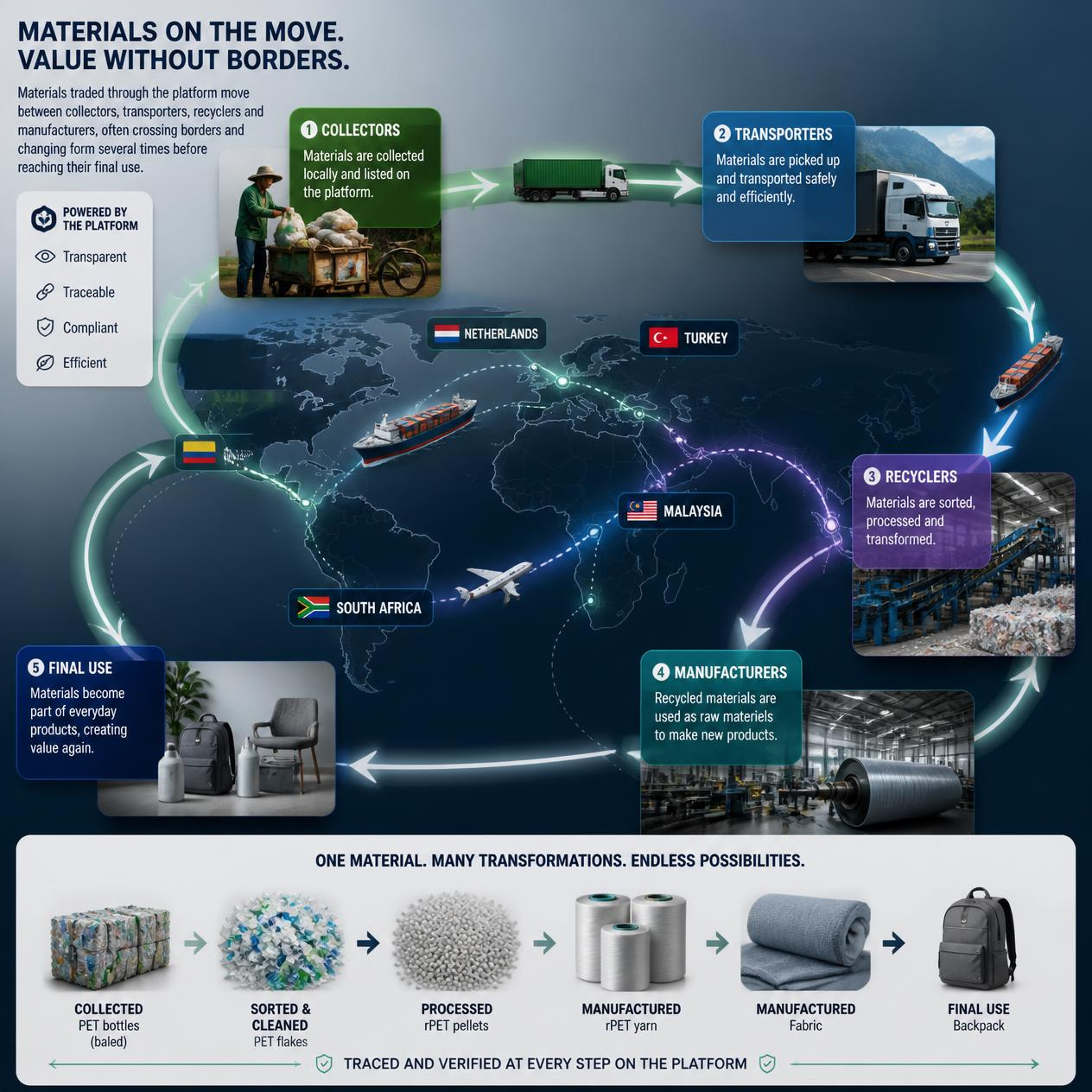
Infographic titled 'Materials on the move. Value without borders.' showing a global flow of materials through collectors, transporters, recyclers, and manufacturers across countries like Netherlands, Turkey, Malaysia, South Africa, and Colombia, illustrated with trucks, ships, and an airplane. Five-step cycle: 1. Collectors gather materials locally. 2. Transporters move materials safely. 3. Recyclers sort and transform materials. 4. Manufacturers use recycled materials to make new products. 5. Final use with products like backpacks and fabric. Bottom section shows PET bottles collected, sorted, processed into rPET pellets, yarn, fabric, then products. The platform ensures transparency, traceability, compliance, and efficiency.

Bringing Digital Product Passports into material trade

WasteTrade is a global B2B marketplace for waste and recyclable materials, connecting collectors, transporters, recyclers and manufacturers as materials cross borders and change form.
Working with EcoWise, WasteTrade has developed Digital Product Passports to keep critical information linked to those materials throughout their journey. A passport begins when a material batch enters the supply chain and grows as new events occur — material data, movement, processing records and evidence forming one continuous digital record, rather than fragments scattered across spreadsheets and systems.
The principle is simple: materials change form, but their history stays traceable — followed through collection, transport, recycling and manufacture.

Eco Wise Provides
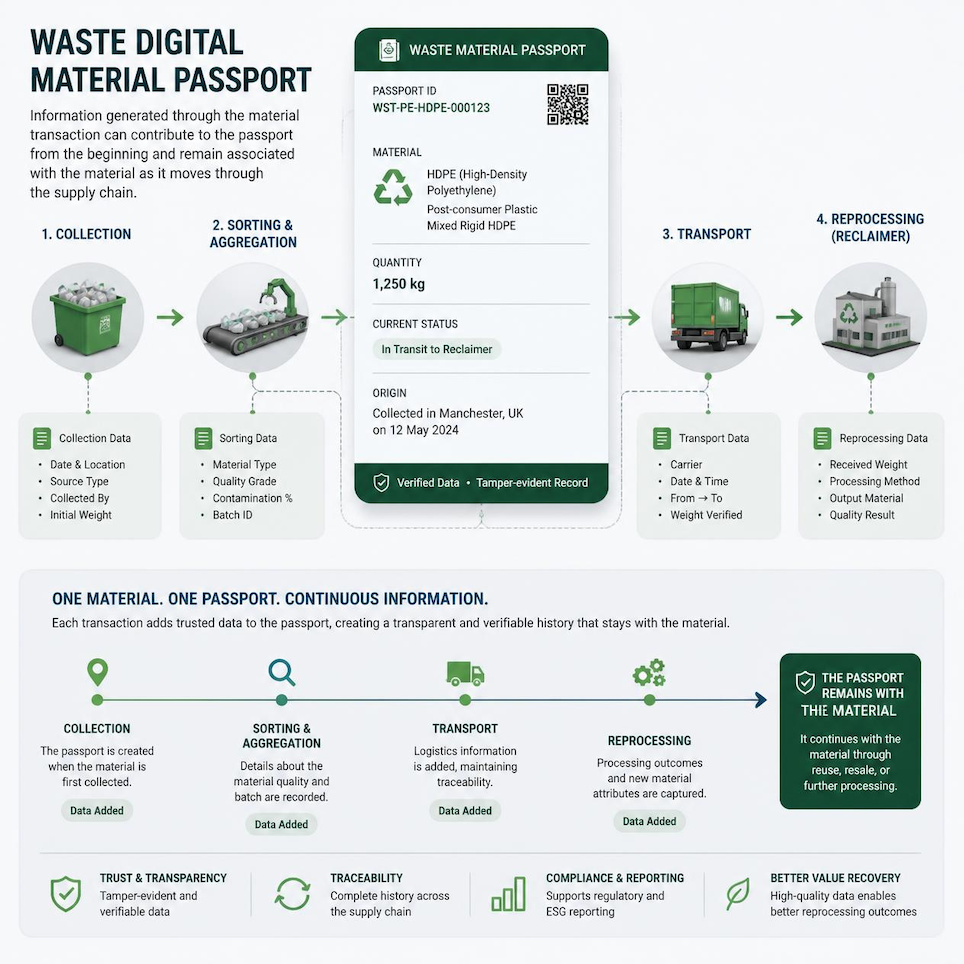
Infographic titled 'Waste Digital Material Passport' describing how material transaction data contributes to a passport tracking waste through supply chain stages: collection, sorting & aggregation, transport, and reprocessing. A digital passport example shows details for HDPE plastic including passport ID, material type, quantity, current status as 'In Transit to Reclaimer,' and origin collected in Manchester, UK on 12 May 2024. Each process stage shows data collected such as collection data (date, location), sorting data (material type, quality), transport data (carrier, date), and reprocessing data (weight, processing method). The passport remains with the material to ensure trust, transparency, traceability, compliance, reporting, and better value recovery.

What WasteTrade Brings‍

WasteTrade provides the commercial and operational environment in which recyclable materials are specified, traded, transported and received.
This gives the DigitalProduct Passport a practical starting point.
Information generated through the material transaction can contribute to the passport from thebeginning and remain associated with the material as it moves through the supply chain.

WasteTrade brings together:
Blue Tick
Material specification and classification
Blue Tick
Trading counterparties
Blue Tick
Transport and movement information
Blue Tick
Relevant Compliance records
Blue Tick
Transaction documentation
Blue Tick
Processing and recycled-content information
Blue Tick
Carbon data through ThinkCarbon
The partnership allows these records to contribute to a continuing material history rather thanremaining isolated around individual transactions.
More details

How the Partnership Creates Value

Secondary-material markets depend heavily on evidence.

A buyer needs to understand what a material is, where it came from and whether it meets the required specification. Recyclers need to record what happened during processing. Manufacturers increasingly need evidence behind recycled-contentand sustainability claims.

In traditional supply chains, that information can become fragmented.

WasteTrade and EcoWise are developing a structure that keeps the relevant records closer to the material they describe

At collection

The opening record can establish the material identity, source, classification, weight and relevant quality information.

During transport

Movement, carrier and handover information can become part of the continuing record.

At recycling

Processing information can connect the incoming material with the recyclate produced from it.

At manufacture

The resulting recycled feedstock can be associated with the production batch or finished product in which it is used.

The physical material may move from bale to flake, pellet and finished product. The passport provides away for the information behind that journey to continue with it.

This is the core of WasteTrade’s Digital Product Passport approach: one material journey supported by an unchanging record that develops at each stage.

Why This Partnership Matters

WasteTrade operates within the physical supply chain. EcoWise provides the digital infrastructure that allows information from that supply chain to be structured, retained and exchanged.

Together, the two companies have developed Waste Digital Product Passports around the way recyclable materials actually move through industry.

For businesses using WasteTrade, that creates a clearer connection between the material being tradeda nd the evidence behind it.

It also provides a stronger foundation for the increasing traceability, recycled-content and product-data requirements developing across European markets.

Together with Eco Wise

Connecting physical materials with digital evidence
‍
WasteTrade brings the marketplace, transaction and material journey.
EcoWise provides the Digital Product Passport infrastructure that allows a structured digital record to develop alongside it.
Together, we are building a more traceable way to trade waste and recyclable materials, with information that remains connected to the material from its first recorded stage through toits next use.

AI Security

Frequently Asked Questions

Why do I need a Digital Product Passport?
How do EcoWise X WasteTrade Digital Product Passports support the recycling supply chain?
Does a Digital Product Passport replace compliance orcertification?
How does a WasteTrade Digital Product Passport work?
How does the joint service work?
What data do I need to provide?
Do I need to change my existing systems?
Is my data secure?
What exactly is a Digital Product Passport?
Why does my DPP data need to be verified or certified?
What happens if I don't act now?
When do the DPP requirements apply to my products?
How long does it take to get a compliant DPP in place?
How do I start?